
Colloquium focuses on leadership, communities and economic transformation
As Ekiti State prepares to mark 30 years of its creation, stakeholders are expected to use the occasion to reflect on the journey so far and examine what must be done to achieve sustainable development in the state.
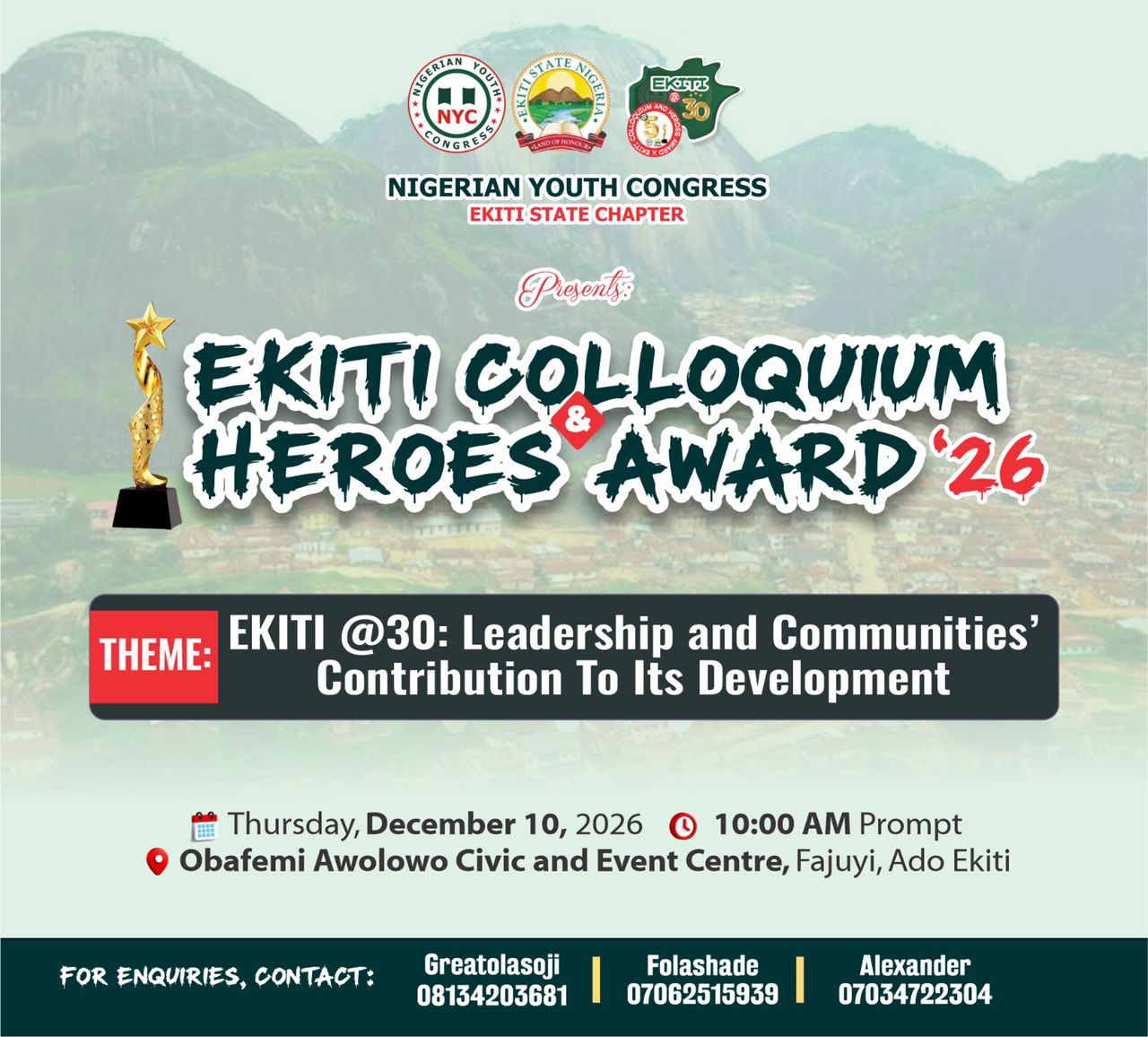
The issues are expected to take centre stage at the Ekiti @30 Colloquium and Heroes Award, now in its fifth edition, with the theme: “Ekiti @30: Leadership and Communities’ Contribution to Its Development.”
Ekiti State was created on October 1, 1996, following years of agitation, consultations, lobbying and negotiations involving political leaders, traditional rulers, professionals, community leaders and other stakeholders.
The creation of the state was the outcome of a collective aspiration by the people of Ekiti for a distinct political identity and greater opportunity to determine their developmental direction.
Thirty years later, however, the focus has shifted from the struggle for state creation to the challenge of using the opportunities provided by statehood to build a stronger economy and improve the standard of living of the people.
The central question now is what kind of state Ekiti should become in the next 30 years.
FROM STATE CREATION TO DEVELOPMENT
The history of Ekiti State demonstrates the power of collective action. The struggle for state creation brought together people across political affiliations and professional backgrounds who rallied around a common objective.
The Ekiti @30 conversation is expected to revisit that history while examining how the same spirit of unity and collective responsibility can be applied to the state’s present development challenges.
Leadership is expected to be a major area of discussion. Stakeholders are expected to examine the role of successive administrations and the need for leadership that thinks beyond electoral cycles and immediate political interests.
The emerging development agenda places emphasis on industrialisation, agriculture, technology, innovation, tourism, the creative economy and entrepreneurship.
Ekiti, known for its strong educational tradition and large population of scholars and professionals, is also being challenged to translate its human capital into businesses, industries, research, innovation and employment opportunities.
The state must, therefore, increasingly move beyond dependence on salaries, government allocations and consumption towards an economy driven by production.
Agricultural resources, including cocoa, cassava, fruits, vegetables and livestock, provide opportunities for processing, packaging, storage and distribution. Similarly, the state’s educational advantage could support technology companies, research institutions, innovation and knowledge-based businesses.
The fundamental question is no longer simply what Ekiti has, but what can be produced from what the state possesses.
COMMUNITIES AND THE NEXT GENERATION
Communities are also expected to receive considerable attention at the colloquium.
Across Ekiti, communities have contributed to development through self-help projects, education, healthcare, infrastructure, philanthropy, security and cultural preservation.
Community development associations, traditional institutions, town unions, professional groups and individuals have continued to support development initiatives in various parts of the state.
Stakeholders are expected to argue that government cannot bear the entire responsibility for development. Greater collaboration among government, communities, traditional institutions, the private sector, professionals and the Ekiti diaspora could help attract investment and strengthen local economic activity.
The role of young people is also expected to feature prominently.
With increasing calls from Ekiti youths for greater attention to industries and economic opportunities, discussions are expected to focus on access to finance, skills, technology, investment and markets.
Stakeholders are expected to emphasise the need to move beyond short-term empowerment programmes towards the creation of an economic environment where young people can establish businesses, develop innovations and create employment.
The Heroes Award component of the programme is also expected to recognise individuals and organisations that have contributed to the creation and development of the state.
Political leaders, traditional rulers, community leaders, teachers, entrepreneurs, investors, philanthropists, professionals and young people who have made significant contributions to Ekiti’s development are among those whose efforts could receive recognition.
THE NEXT 30 YEARS
As Ekiti marks three decades of statehood, the anniversary provides an opportunity to celebrate the sacrifices of those who fought for the creation of the state while also assessing the responsibilities of the present generation.
The next phase of the Ekiti project is expected to focus on building a state that produces, attracts investment, creates industries, promotes innovation, strengthens agriculture and provides greater opportunities for its young population.
The Ekiti @30 Colloquium and Heroes Award @5 is therefore positioned not only as a celebration of the state’s history, but also as a platform for reflection and a call for stronger leadership and broader participation in the development of Ekiti.
Thirty years ago, the struggle was for the creation of Ekiti State.
Today, the challenge is to transform that political achievement into sustainable economic development and prosperity for the people.
The struggle for creation has been won. The struggle for development continues.
Welcome to Ekiti @30 and Ekiti Colloquium and Heroes Award @5.



Facebook Comments